Meet the New iThrottle: Smarter Throttle Control, Vehicle Security and Diagnostics in One System
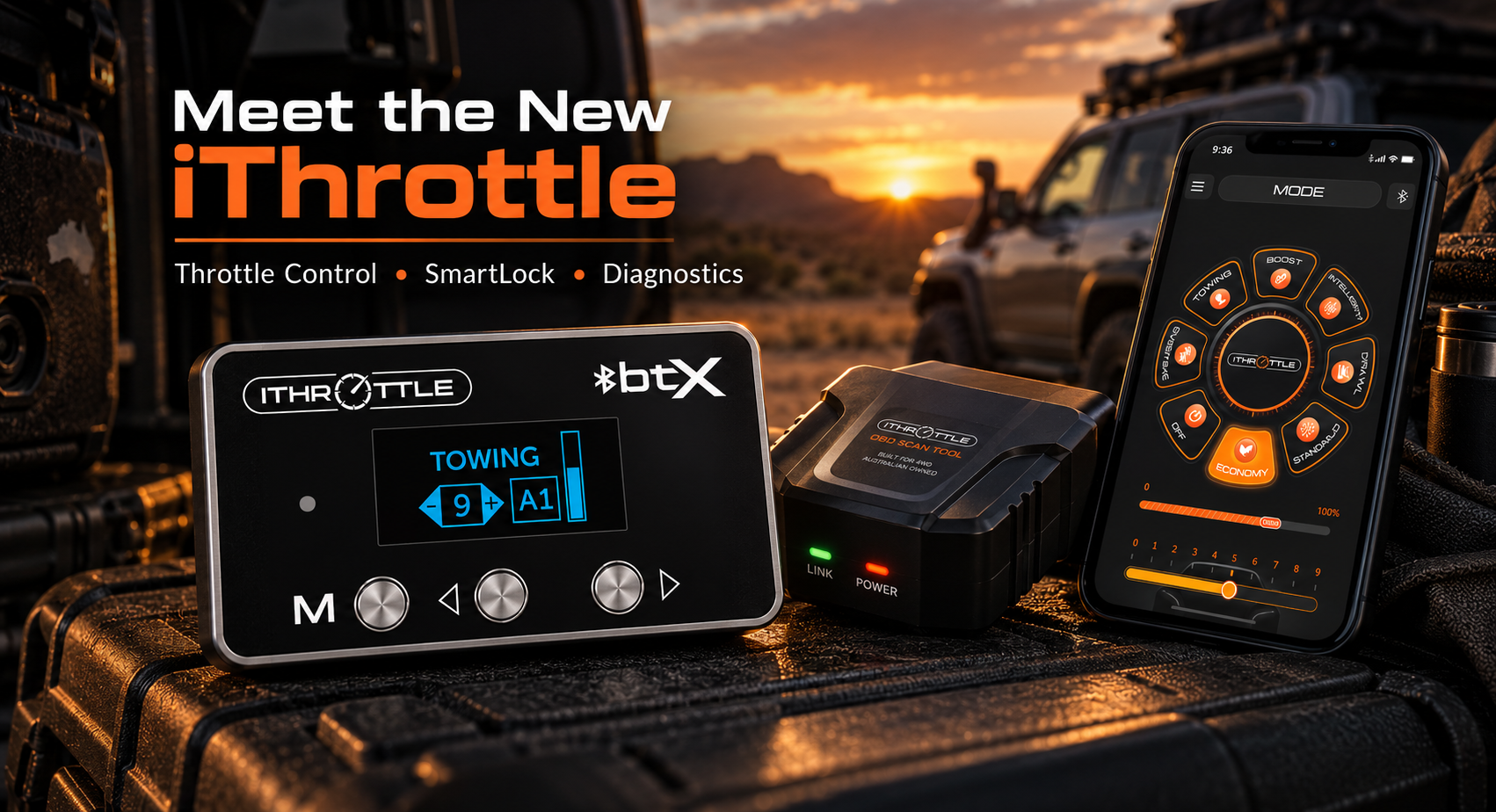
Modern 4WDs are packed with technology, but that does not always mean they deliver the driving experience owners want straight from the factory.
Throttle lag can make a vehicle feel slow to respond. Towing can highlight hesitation when pulling away or climbing hills. Technical off-road driving often calls for smoother, more controlled pedal input. At the same time, vehicle security and access to useful diagnostic information have become increasingly important for Australian 4WD owners.
The new iThrottle Controller has been developed to bring these needs together in one smarter system.
Rather than focusing solely on sharper throttle response, the latest iThrottle combines multiple driving modes, adjustable sensitivity, automatic pedal immobilisation, smartphone functionality, Winch Mode, Rumble Mode and optional OBDII engine diagnostics.
It is designed to give drivers more control over how their vehicle responds, while also adding useful security and monitoring functionality through the broader iThrottle system.
A Throttle Controller That Does More Than Change Throttle Response
Traditional throttle controllers are relatively simple in concept.
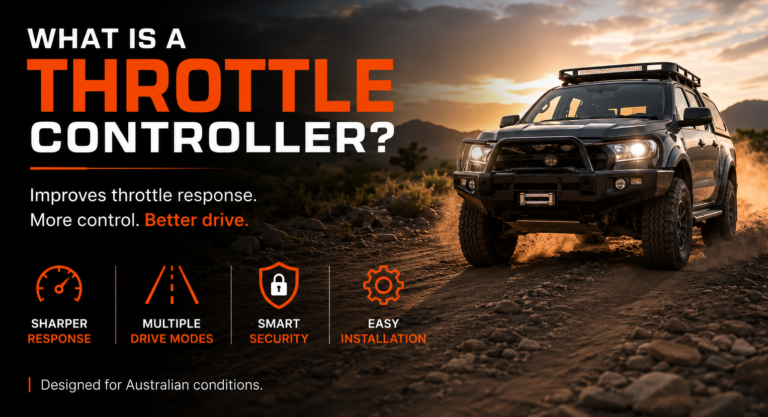
Modern vehicles use an electronic accelerator pedal rather than a direct mechanical cable between the pedal and throttle body. When you press the accelerator, the vehicle interprets that electronic input and determines how quickly the throttle responds.
A throttle controller modifies that accelerator input signal to change the way the vehicle responds to pedal movement.
That means it can make the accelerator feel:
- Sharper and more responsive
- Smoother and more progressive
- Better suited to towing
- Easier to control in technical terrain
- More relaxed for everyday driving
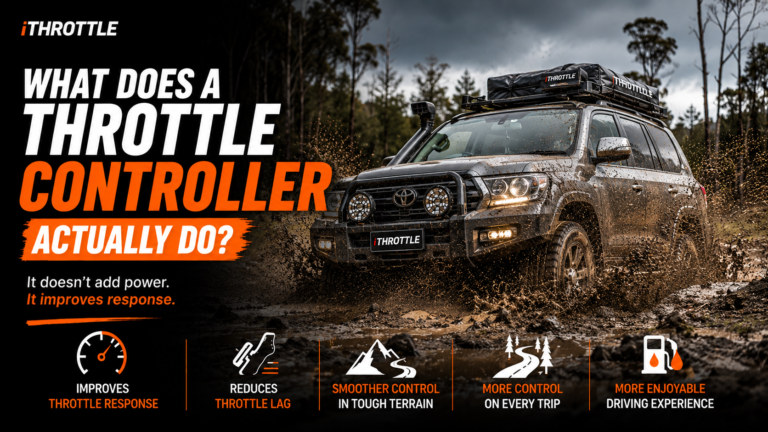
What it does not do is increase engine horsepower.
The engine still produces the same underlying power. The difference is in how quickly and progressively that power is requested when you move the accelerator pedal.
The new iThrottle builds on this basic principle by adding features that extend well beyond normal throttle adjustment.
Why Throttle Lag Can Be So Noticeable in Modern 4WDs
Throttle lag is the short delay or soft response some drivers notice after pressing the accelerator.
You may experience it when:
- Pulling away from traffic lights
- Entering a roundabout
- Merging into traffic
- Accelerating while towing
- Climbing a steep hill
- Driving through soft sand
- Negotiating technical off-road terrain
Vehicle manufacturers deliberately calibrate electronic throttle systems to balance factors such as emissions, fuel consumption, comfort and drivability.
For some drivers, particularly those using heavier 4WDs, utes or towing setups, the factory response can feel overly conservative.
A throttle controller allows the driver to change that response without increasing engine output or modifying the factory ECU tune.
Multiple Driving Modes for Different Conditions
One of the strongest features of the new iThrottle is the ability to adjust throttle behaviour according to what you are actually doing with the vehicle.
Rather than forcing one aggressive setting to work everywhere, iThrottle provides dedicated modes for different driving conditions.
The current iThrottle system includes modes for performance, economy, towing, crawling, loose terrain, adaptive driving, security and other specialised uses. The new generation also allows sensitivity to be adjusted to further fine tune the response.
Boost Mode
Boost Mode is designed for drivers who want a sharper accelerator response.
It increases throttle sensitivity across the pedal range, with particular emphasis on low and mid throttle inputs.
This can make the vehicle feel significantly more responsive when:
- Pulling away
- Merging
- Accelerating onto a highway
- Driving in everyday traffic
- Climbing hills
The important distinction is that Boost Mode changes response, not horsepower.
You are accessing the available throttle more quickly from the same amount of pedal movement.
Economy Mode
Not every situation calls for sharper throttle response.
Economy Mode works in the opposite direction by softening accelerator sensitivity.
This can make it easier to apply gentle throttle inputs during everyday driving, particularly in traffic or on longer highway trips.
A softer pedal can also help reduce unnecessary throttle movement caused by small changes in foot position.
Full throttle remains available when required, so the mode is intended to make normal driving smoother rather than permanently restricting the vehicle’s performance.
Towing Mode
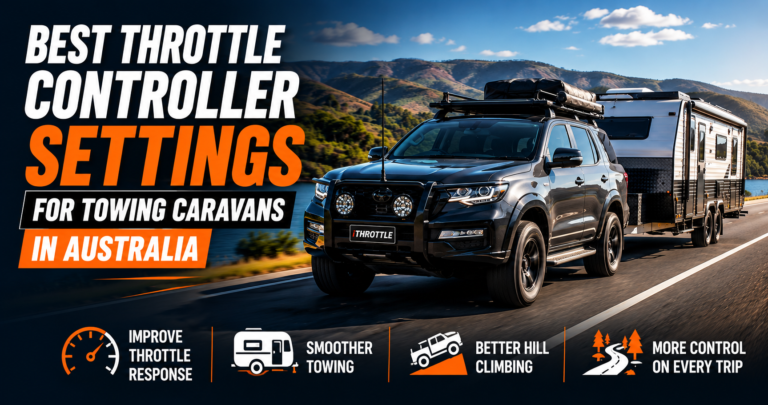
Towing is one of the situations where factory throttle calibration can become especially noticeable.
Add a caravan, boat or heavy trailer and the vehicle has considerably more weight to move.
Towing Mode is designed to retain a smoother response during lighter throttle use while increasing response as greater accelerator input is applied.
This can be useful when:
- Pulling away with a caravan
- Climbing hills
- Joining faster traffic
- Overtaking
- Maintaining momentum with a loaded vehicle
The objective is not to create more engine power. Instead, it gives the driver easier access to the performance that is already available.
For touring drivers, this can make the vehicle feel more predictable and responsive under load.
Crawl Mode
Technical off-road driving often requires the exact opposite of aggressive throttle response.
When crawling over rocks, ruts or uneven terrain, too much accelerator input can cause wheel spin or make the vehicle surge forward unexpectedly.
Crawl Mode softens the throttle response so that small pedal movements produce more controlled changes in vehicle speed.
This gives the driver finer control when navigating:
- Rock sections
- Deep ruts
- Steep tracks
- Low-speed obstacles
- Uneven terrain
The result is a more progressive pedal that can make precise off-road manoeuvring easier.
Sand & Mud Mode
Driving through sand and mud presents a different challenge.
Maintaining momentum is important, but an overly aggressive throttle response can also make traction harder to manage.
Sand & Mud Mode is calibrated specifically for these loose and slippery conditions.
The goal is to provide a more progressive response that helps the driver manage power delivery more confidently when traction is constantly changing.
Intelligent Mode
Different drivers naturally use the accelerator differently.
Some apply smooth, gradual inputs. Others prefer a more immediate response.
Intelligent Mode is designed to adapt to the driver’s throttle behaviour over time.
The system progressively fine tunes throttle enhancement based on how the accelerator is being used, helping balance:
- Smooth low-speed control
- Everyday drivability
- Responsive acceleration
- Overtaking performance
Rather than requiring the driver to constantly change settings, Intelligent Mode provides a more adaptive approach.
Off Mode
There are times when you may simply want the vehicle to behave exactly as it did from the factory.
Off Mode returns throttle behaviour to the standard factory response with no throttle enhancement.
This is useful when you want to compare settings or simply prefer the original accelerator feel for a particular drive.
Winch Mode: A Feature Designed for 4WD Recovery
Winching places significant electrical demand on a 4WD.
A winch can draw substantial current, putting increased load on the battery and alternator.
This is where Winch Mode provides a different type of functionality.
Rather than adjusting throttle response for driving, Winch Mode allows the engine RPM to be raised and maintained while the vehicle is stationary during winching.
The current system provides multiple adjustable RPM levels so the driver can select a setting suitable for the recovery situation.
This can help support alternator output and reduce some of the electrical strain associated with prolonged winch operation.
It may also be useful when operating other equipment that benefits from a controlled increase in engine RPM.
For 4WD owners who regularly travel remotely or tackle difficult tracks, this makes Winch Mode much more than another throttle sensitivity preset.
SmartLock™ Adds Automatic Pedal Immobilisation
One of the biggest changes in the new iThrottle is the introduction of automatic pedal immobilisation.
The SmartLock system is designed to disable accelerator pedal operation when the vehicle is secured.
The new system can automatically lock and unlock using the authorised driver’s smartphone through Bluetooth proximity.
That means everyday use can be considerably simpler than a traditional system that requires the owner to remember to activate a security mode each time they leave the vehicle.
The concept is straightforward.
When the authorised phone moves away from the vehicle, SmartLock can secure the accelerator pedal.
When the authorised phone returns within the required Bluetooth range, the system can unlock again.
For normal use, there is no need to manually activate the security feature every time you park.
Why Automatic Locking Matters
Security features only provide value when they are actually used.
One problem with manual security systems is that it is easy to forget them.
You park the vehicle, grab your belongings and walk away.
If a security mode needs to be manually enabled every single time, there will inevitably be occasions when it is forgotten.
Automatic locking addresses that weakness by making the security function part of the driver’s normal routine.
There is nothing extra to remember during everyday use.
SmartLock Is an Additional Security Layer
It is important to understand what SmartLock is designed to do.
It disables accelerator pedal operation through the throttle controller system.
It should therefore be considered an additional layer of vehicle security, rather than a replacement for your factory immobiliser, alarm, steering lock or other security equipment.
Layered security is generally a stronger approach because different devices protect the vehicle in different ways.
For example, a 4WD owner might combine:
- Factory immobilisation
- SmartLock pedal immobilisation
- A physical steering wheel lock
- Protection of the OBDII port
- GPS tracking or monitoring
No individual security product can guarantee that a vehicle cannot be stolen, but multiple independent layers can make unauthorised vehicle movement considerably more difficult.
Rumble Mode Brings Another Level of Customisation
The new iThrottle also introduces Rumble Mode.
Unlike the normal driving modes, Rumble Mode is designed for use while the vehicle is stationary.
It uses controlled throttle inputs to create a deeper and more distinctive exhaust rumble.
The feature can be managed through the iThrottle Smart App, where supported settings can be adjusted from a smartphone.
Drivers can select from preset profiles or customise aspects of the effect according to their preference.
It is a good example of how the new iThrottle has evolved beyond simply changing accelerator sensitivity.
Bringing the System Together With the iThrottle Smart App
Smartphone connectivity plays a much bigger role in the new generation.
The iThrottle Smart App provides a central point for supported controller functions and additional features.
Depending on the connected hardware and configuration, the system can bring together functionality such as:
- Throttle control
- Driving mode management
- SmartLock functionality
- Rumble Mode settings
- Vehicle diagnostics
That means the throttle controller is no longer operating purely as an isolated device mounted on the dashboard.
It becomes part of a broader connected system.
Optional OBDII Scan Tool and Engine Diagnostics
Another major addition is the ability to integrate an optional OBDII Scan Tool and Engine Diagnostic system.
Modern vehicles constantly monitor sensors and electronic systems through the vehicle’s onboard computer.
When something falls outside the expected range, the vehicle may store a diagnostic trouble code and illuminate a warning light.
Without a diagnostic scanner, the driver often has very little information beyond the warning light itself.
The optional iThrottle OBDII functionality is designed to provide greater visibility into what the vehicle is doing.
Current iThrottle product information describes the system as allowing users to monitor live engine data and identify and clear supported fault codes through the iThrottle ecosystem.
Why Diagnostics Matter for Touring
A check engine light appearing during the morning commute is inconvenient.
A check engine light appearing hundreds of kilometres from the nearest workshop is a completely different problem.
Remote touring is where access to diagnostic information can become particularly valuable.
A scan tool may help you determine whether a warning relates to something that requires immediate professional attention or whether it is a stored fault that can at least be identified before arranging assistance.
That does not turn every driver into a mechanic, and a diagnostic tool should never be used to ignore serious faults.
What it does provide is information.
When travelling remotely, knowing what fault code the vehicle has stored can be far more useful than simply seeing an unexplained warning light on the dashboard.
Live Vehicle Information in One System
Diagnostics are not only useful when something goes wrong.
Access to supported live engine information can also help drivers better understand how their vehicle is operating.
This can be particularly relevant during:
- Long-distance touring
- Heavy towing
- Remote travel
- Extended climbs
- Hot Australian conditions
The optional diagnostic functionality therefore complements the throttle controller rather than simply duplicating it.
Throttle control changes how the vehicle responds.
Diagnostics help you understand what the vehicle is reporting.
SmartLock adds another layer of security.
Together, those functions create a much broader vehicle management system.
Simple Plug and Play Installation
Despite the additional functionality, the basic throttle controller installation remains relatively straightforward.
The iThrottle controller connects inline with the accelerator pedal position sensor.
The factory harness is disconnected from the accelerator pedal, the supplied iThrottle harness is connected in between, and the controller becomes part of the electronic throttle signal path.
There is no need to cut the factory wiring for the standard controller installation.
This also makes the installation reversible if the controller ever needs to be removed.
Vehicle compatibility still matters, so drivers should select the correct make, model, year and engine configuration when ordering.
Does the New iThrottle Increase Horsepower?
No.
This is one of the most important things to understand about any throttle controller.
A throttle controller does not increase the engine’s maximum horsepower or torque.
Instead, it modifies the relationship between accelerator pedal movement and throttle response.
Imagine that the factory vehicle requires a relatively large accelerator movement before giving you the response you want.
A sharper throttle controller setting can request that response with less pedal movement.
The vehicle feels more responsive, but the underlying engine output has not been increased.
This distinction is important because throttle response and engine power are two different things.
Is a Throttle Controller the Same as an ECU Tune?
No.
An ECU tune can change parameters relating to engine operation and may alter actual power and torque output.
A throttle controller primarily changes accelerator pedal response.
For many drivers, that is exactly what they want.
They are happy with the vehicle’s power but dislike the delay or softness in the accelerator.
A throttle controller addresses that specific issue without trying to turn the vehicle into something it was never intended to be.
Who Is the New iThrottle Designed For?
The new iThrottle makes sense for a wide range of drivers because the system is no longer focused on a single driving style.
Everyday 4WD Drivers
Drivers who mainly use their 4WD around town can use a more responsive mode for commuting or choose a softer setting when they want relaxed driving.
Caravan and Trailer Owners
Towing Mode provides a throttle profile designed around the different demands of moving additional weight.
Off-Road Drivers
Crawl Mode and Sand & Mud Mode provide different approaches for technical terrain and loose surfaces.
Remote Tourers
Winch Mode and optional OBDII diagnostics add functionality that becomes particularly useful when travelling away from workshops and roadside assistance.
Security Conscious Owners
SmartLock provides automatic accelerator pedal immobilisation as another layer alongside existing factory and aftermarket security.
Drivers Who Like to Fine Tune Their Vehicle
Multiple drive modes, adjustable sensitivity and app based functionality allow drivers to tailor the vehicle’s response rather than accepting one fixed throttle map for every situation.
Compatible With Popular Australian 4WDs
The iThrottle range supports a broad selection of popular Australian 4WDs and utes, with current vehicle options including models from Toyota, Ford, Isuzu, Nissan, Mitsubishi, GWM, Mazda, RAM, Jeep, Holden, Chevrolet, Land Rover, LDV and Volkswagen.
Depending on vehicle compatibility, this includes popular models such as:
- Toyota Hilux
- Toyota Prado
- Toyota LandCruiser
- Ford Ranger
- Ford Everest
- Isuzu D-MAX
- Isuzu MU-X
- Nissan Navara
- Nissan Patrol
- Mitsubishi Triton
- Mitsubishi Pajero Sport
- Mazda BT-50
- Volkswagen Amarok
- GWM Cannon
- GWM Tank 300
- GWM Tank 500
- RAM models
- Chevrolet Silverado
Always check the vehicle selector before ordering to confirm the correct fitment.
More Control Without Making Driving Complicated
One of the challenges with adding more technology is making sure the product does not become harder to use.
A long list of complicated settings is not necessarily useful if the driver cannot quickly select the right one.
The approach behind the new iThrottle is to provide purpose specific modes that make sense in real driving situations.
If you are towing, select the towing setup.
If you are crawling over technical terrain, use Crawl Mode.
If you want sharper everyday response, choose a performance setting.
If you want factory response, return to Off Mode.
If you are winching, Winch Mode serves a completely different purpose again.
The technology becomes useful because each function has a clear reason for being there.
Throttle Response, Security and Diagnostics in One Ecosystem
The biggest change with the new iThrottle is not any single mode.
It is the way the different functions now work together.
A traditional throttle controller focuses almost entirely on accelerator response.
The latest iThrottle expands that concept into three broader areas.
Performance and control: Multiple throttle modes help adapt accelerator response to everyday driving, towing and different terrain.
Vehicle security: SmartLock automatic pedal immobilisation adds another barrier against unauthorised vehicle movement.
Vehicle information: Optional OBDII diagnostics provide access to supported engine data and fault codes.
Add smartphone integration, Winch Mode and Rumble Mode, and the result is a significantly broader system than a conventional throttle controller.
Frequently Asked Questions
Does the iThrottle increase horsepower?
No. iThrottle changes accelerator response rather than increasing the engine’s maximum horsepower or torque.
Can I return the vehicle to factory throttle response?
Yes. Off Mode returns the throttle response to the standard factory behaviour.
Is iThrottle useful for towing?
Yes. Towing Mode is designed to provide smoother response during normal driving while increasing throttle sensitivity as greater accelerator input is required.
What does Crawl Mode do?
Crawl Mode softens throttle response to provide finer accelerator control during technical low-speed off-road driving.
What is SmartLock?
SmartLock is iThrottle’s automatic pedal immobilisation feature. It can disable accelerator pedal operation when the vehicle is secured and automatically unlock when the authorised phone returns within Bluetooth range.
Does SmartLock replace my vehicle’s factory immobiliser?
No. SmartLock should be considered an additional security layer rather than a replacement for the vehicle’s existing security systems.
What is Winch Mode?
Winch Mode allows the engine RPM to be raised and maintained during winching, with adjustable RPM levels available for different recovery situations.
What does the optional OBDII Scan Tool do?
The optional diagnostic system can provide access to supported engine information and diagnostic trouble codes, helping drivers identify and clear compatible faults through the iThrottle system.
Is installation permanent?
The standard throttle controller installation connects inline with the accelerator pedal harness and does not require cutting the factory wiring.
Can I use iThrottle for normal everyday driving?
Yes. Drivers can choose a throttle response that suits normal commuting and switch modes when towing, touring or heading off-road.
The Next Generation of iThrottle
The new iThrottle has moved well beyond the idea that a throttle controller should simply make the accelerator feel sharper.
It is designed around the way Australian 4WD owners actually use their vehicles.
One day that might mean commuting through traffic.
The next might involve towing a caravan up a steep highway.
On the weekend it could mean navigating a rocky track, driving through sand or recovering another vehicle with a winch.
And throughout all of it, owners increasingly want better vehicle security and more information about what is happening under the bonnet.
The latest iThrottle brings those functions together into one connected system.
You still get the throttle response control that made throttle controllers popular in the first place, but now it is supported by dedicated driving modes, SmartLock pedal immobilisation, smartphone control, Winch Mode, Rumble Mode and optional OBDII diagnostics.
For drivers looking for more control over their 4WD without changing the vehicle’s engine power, the new iThrottle offers a much broader approach.
Smarter throttle control. Added vehicle security. Useful engine diagnostics. One iThrottle system.